The impact of adaptive mesh refinement on astrophysical turbulence
This project investigates how adaptive mesh refinement influences the statistical properties of turbulence in numerical simulations. By comparing simulations with different refinement strategies, it aims to determine how reliably adaptive methods capture turbulent cascades, mixing, and small-scale structure formation.
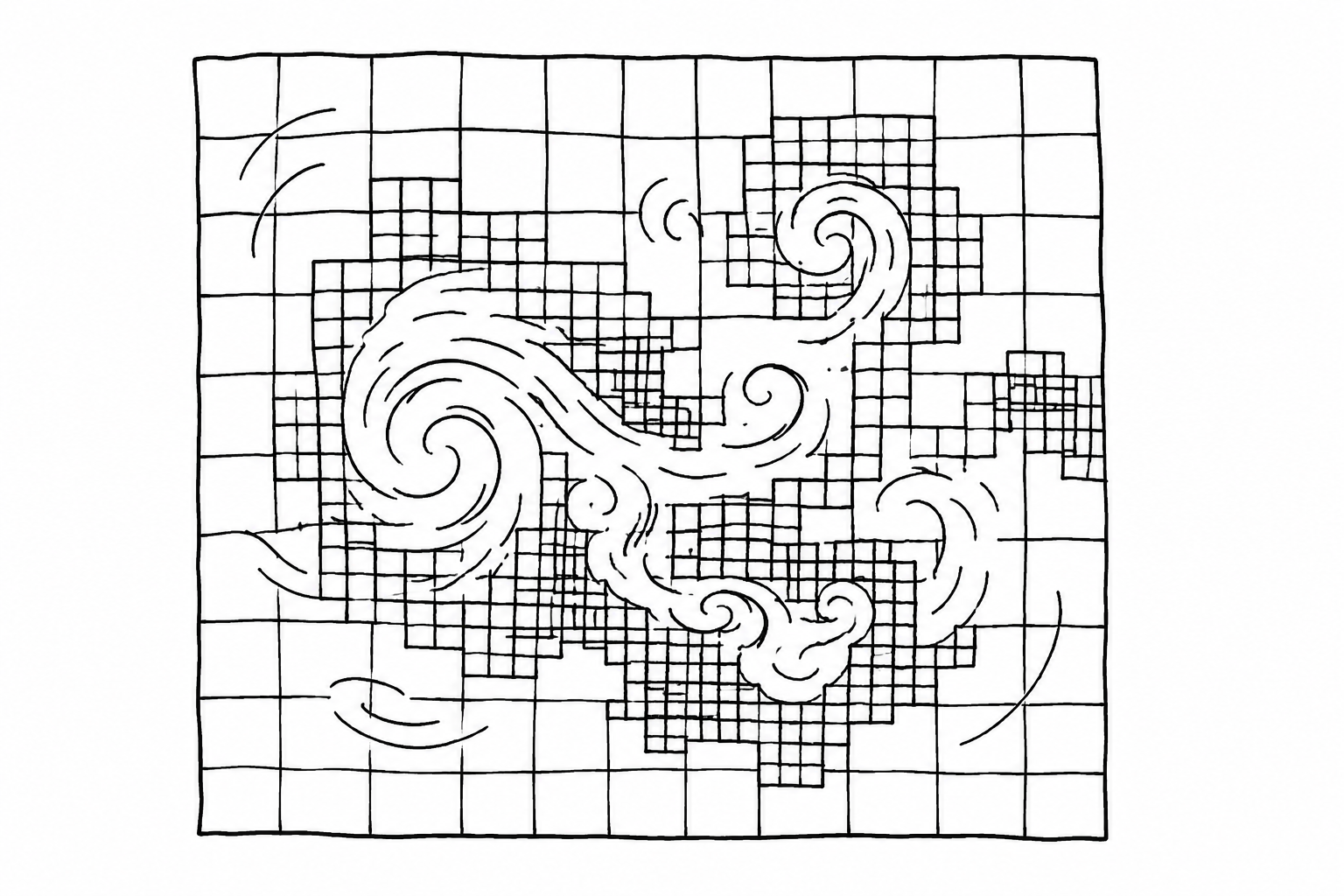
Turbulence plays a central role in many astrophysical systems, ranging from the interstellar medium and galaxy clusters to stellar atmospheres and accretion flows. Because fully resolving all relevant scales is computationally impossible, many simulations employ adaptive mesh refinement (AMR), which dynamically increases the resolution only where it is deemed necessary. While this approach greatly reduces computational cost, it may also influence the turbulent cascade and the resulting gas structure.
In this project you will perform and analyze turbulence simulations using different refinement strategies. By comparing quantities such as velocity power spectra, density distributions, turbulent dissipation rates, and mixing efficiencies, you will investigate how adaptive meshes affect the statistical properties of turbulence and identify potential biases introduced by commonly used refinement criteria.