Jet-ISM interactions and radiative energy losses
This project studies how energetic jets interact with the turbulent, multiphase interstellar medium of galaxies. By performing hydrodynamical or magnetohydrodynamical simulations, it aims to quantify how much jet energy is radiated away, how efficiently the ISM is heated or stirred, and under which conditions jets stall before escaping the galaxy.
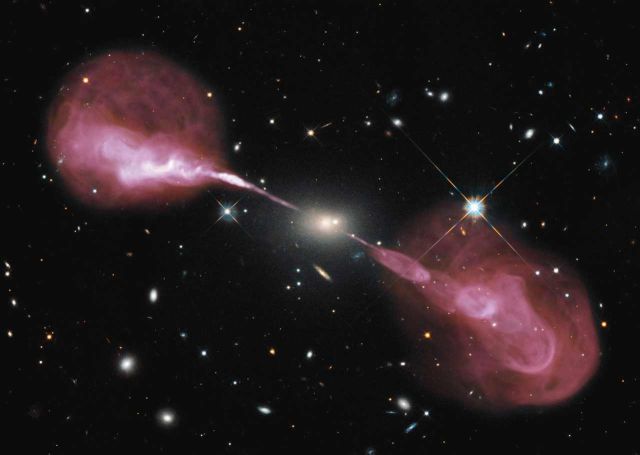
Relativistic jets launched by accreting black holes can have a major impact on the gas in their host galaxies. As they propagate through the dense and highly structured interstellar medium, they inflate bubbles, drive shocks, stir turbulence, and compress or destroy cold gas clouds. However, not all of the injected jet energy necessarily couples efficiently to the galaxy: part of it may be lost through radiative cooling, while in other cases the jet may stall and deposit most of its energy locally.
In this project you will perform idealized hydrodynamical or magnetohydrodynamical simulations of a jet propagating through a multiphase ISM. The goal is to measure how the injected energy is partitioned into kinetic, thermal, magnetic, and radiated components, and to determine under which conditions the jet breaks out of the ISM or stalls inside the galaxy.